Why Pro-Palestine Protests Flourish in the West but Alarm Arab Governments

Updated: Sep 7
By Uri Pilichowski
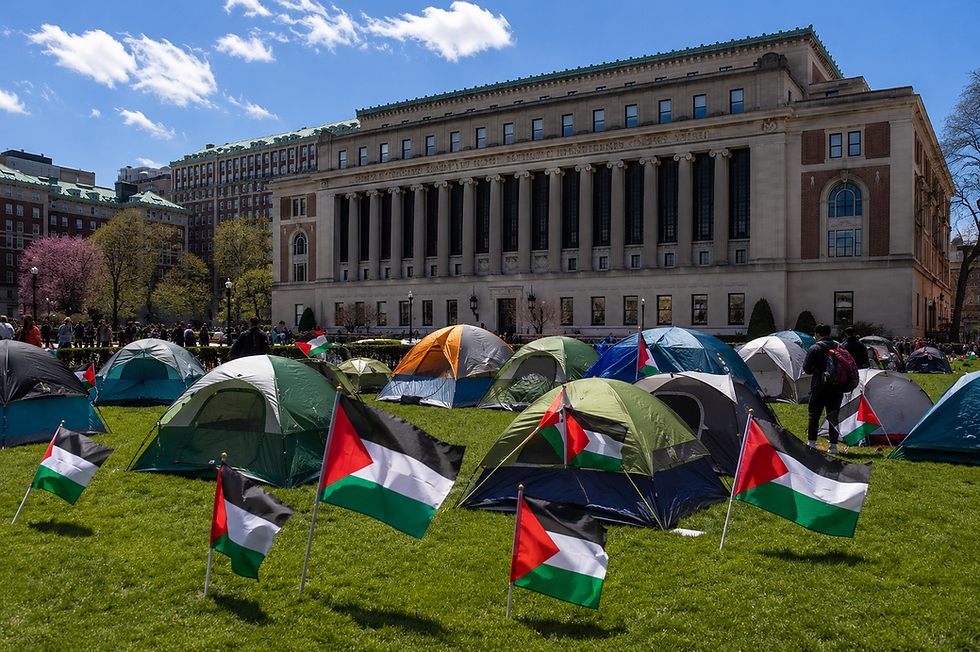
Western democracies generally treat pro-Palestine demonstrations as protected dissent. Many Arab governments see the same mobilization as a potential vehicle for Islamist recruitment, political disruption and challenges to state authority.
On July 30, British police arrested 117 demonstrators outside Westminster Magistrates’ Court for publicly supporting Palestine Action, an organization the government proscribed as a terrorist group in 2025. On the same day, Britain’s Supreme Court agreed to hear a challenge to the ban, placing the dispute at the center of a wider debate over political protest, organized disruption and the limits of democratic tolerance.
More than 3,000 people have been arrested since Palestine Action was outlawed, while more than 1,200 have reportedly been charged under Britain’s Terrorism Act. The government maintains that the organization crossed the line from civil disobedience into politically motivated violence and property destruction. Its supporters argue that the ban criminalizes legitimate protest and suppresses opposition to Israel’s military campaign in Gaza. The Supreme Court must now consider where political activism ends and terrorism law legitimately begins. The Associated Press reported on the arrests and legal challenge.
The controversy captures a dilemma that has confronted Western democracies since October 7, 2023: how should open societies distinguish between legitimate humanitarian advocacy, disruptive political activism and organized movements pursuing more radical objectives?
The scale of the mobilization has been extraordinary. According to the Armed Conflict Location & Event Data Project, nearly 48,000 pro-Palestine demonstrations were recorded across 137 countries and territories between October 2023 and September 2025. Approximately 6,100 took place in the United States and Canada, while more than 8,200 were recorded across Europe and Central Asia. Australia registered more than 900 demonstrations, placing it among the countries with the most sustained pro-Palestine protest activity.
A separate dataset compiled by the Crowd Counting Consortium, a joint project of Harvard Kennedy School and the University of Connecticut, recorded nearly 12,400 pro-Palestine actions in the United States alone between October 7, 2023, and June 7, 2024.
The higher American figure reflects a broader methodology and should not be added directly to ACLED’s regional total. But it reinforces the central point: within months, pro-Palestine mobilization had become one of the largest and most persistent protest waves in recent American history.
Britain became one of the movement’s most visible centers, with repeated national marches through London, university encampments, transportation disruptions and direct-action campaigns against companies accused of supporting Israel. Canada experienced sustained demonstrations in Toronto, Montreal and Ottawa. Across France, Germany, Spain, Italy and the Netherlands, Gaza repeatedly became a focus of domestic political confrontation. Australia likewise witnessed major marches, campus occupations and disruptions at ports and government buildings.
Organizers generally present these demonstrations as expressions of solidarity with Palestinian civilians and exercises in free speech and peaceful assembly. For many individual participants, that is undoubtedly the primary motivation.
Yet the scale, persistence and organizational sophistication of the movement raise a second question: Why have demonstrations centered on Palestine become an enduring feature of public life across the West while many Arab governments—despite publicly supporting the Palestinian cause—treat comparable independent mobilization as a potential security threat?
The usual explanation is that Western countries are democracies while Arab governments are authoritarian. That is true, but incomplete. Many Arab governments also understand from experience that Palestine is not merely a humanitarian cause. It can serve as an exceptionally powerful vehicle for political recruitment, Islamist organization and challenges to state authority. Western institutions tend to view protest as protected dissent and a democratic safety valve. Arab governments, having repeatedly confronted nationalist, revolutionary and Islamist movements that used Palestine to build broader political campaigns, are more likely to see the same mobilization as the organizational infrastructure for something larger.
This divergence reveals more than a difference in political values. It reflects a fundamentally different strategic calculus about who organizes mass protest, which movements benefit from it and where public anger may ultimately be directed.
How the Palestinian Cause Became a Tool of Political Mobilization
The Palestinian cause carries an emotional power unmatched by almost any other political issue in the Arab and Muslim worlds. It evokes occupation, displacement, humiliation, religious identity, Western intervention and resistance. That resonance makes it an especially effective tool for mass mobilization.
During the 20th century, Arab nationalist and leftist movements used Palestine to challenge conservative monarchies and Western-aligned governments. Islamist groups later incorporated the cause into their own political strategies. Organizations influenced by the Muslim Brotherhood proved particularly effective at using Palestinian solidarity to expand networks, recruit supporters, raise funds and portray incumbent governments as morally compromised or insufficiently committed to Islam.
The relationship between Hamas and the Brotherhood is not speculative. Hamas’s original 1988 charter described the organization as one of the wings of the Muslim Brotherhood in Palestine. Although Hamas presented a revised political document in 2017 and sought to broaden its nationalist image, its history, networks and ideological development remain closely connected to the Brotherhood tradition.
A demonstration that begins with Gaza can therefore expand into opposition to normalization with Israel, relations with the United States, economic policy, government corruption or the legitimacy of the ruling system itself.
That does not mean every demonstration follows this path or that every protester supports an Islamist agenda. Most political movements are coalitions of people with different motivations. A participant may be driven by concern for civilian suffering while the organization coordinating the event seeks broader political influence.
The relevant question for governments is not only why individuals attend. It is who provides the infrastructure, selects the slogans, controls the messaging, raises the money and retains the contact lists after the crowd goes home.
Why Gulf States Restrict Independent Protest Movements
Saudi Arabia and the United Arab Emirates have spent years weakening Islamist movements and restricting independent political organization. Both regard the Muslim Brotherhood and similar transnational networks as threats to the existing political order.
From the perspective of Gulf leaders, the Brotherhood is not merely a conservative religious movement. It is an ideological competitor that places transnational Islamic solidarity above loyalty to individual nation-states and has historically sought to build political power through mosques, charities, professional associations, educational institutions and social-service networks.
Allowing large, independently organized demonstrations over Palestine could create political space for precisely the movements Gulf governments have worked to dismantle. The risk is particularly sensitive as Saudi Arabia and the UAE pursue ambitious economic modernization strategies dependent on political predictability, foreign investment, tourism and close security relationships with the United States and Europe.
Saudi Arabia’s Vision 2030 and the UAE’s global investment model are built around a national promise: stability, development and economic opportunity in place of ideological confrontation and political upheaval. Mass mobilization can threaten that bargain.
A protest ostensibly directed against Israel can evolve into a campaign against normalization, American military partnerships, domestic economic policies or the rulers themselves. Gulf governments therefore prefer to channel public sympathy through official humanitarian campaigns, state-approved charities, diplomacy and controlled media coverage rather than autonomous street movements.
In the UAE, where political assembly is already heavily restricted, much pro-Palestinian advocacy has occurred among Emiratis abroad rather than inside the country. Saudi Arabia has similarly left little room for independent street protest, regardless of the cause. Bahrain has allowed some demonstrations but has also arrested or prosecuted activists when their campaigns challenge the monarchy, normalization or wider regional policy.
This is not evidence that every Gulf government is indifferent to Palestinian suffering. It reflects a determination to prevent a foreign-policy cause from becoming an independent domestic political movement.
Morocco Permits Protest—but Polices the Political Boundaries
Morocco presents a more complicated case and should not be placed in the same category as the UAE or Saudi Arabia. The kingdom has permitted some of the Arab world’s largest pro-Palestine demonstrations. Tens of thousands of Moroccans from across the political spectrum have marched in support of Palestinians and against Morocco’s normalization agreement with Israel.
At the same time, the government has prosecuted activists whose campaigns or online statements directly challenge the monarchy’s normalization policy. In April 2024, a Moroccan court sentenced activist Abdul Rahman Zankad to five years in prison after he posted criticism of the kingdom’s relations with Israel. Zankad was affiliated with Al Adl wal-Ihsan, an Islamist movement that opposes both normalization and the monarchy’s political model. The sentence drew criticism from civil-liberties organizations, while the case illustrated the boundary Moroccan authorities seek to maintain: public sympathy for Palestinians may be tolerated, but organized opposition to the king’s strategic decisions is treated very differently. The Associated Press reported on the conviction and the wider demonstrations.
Morocco’s government is balancing two competing realities. Public sympathy for Palestinians is widespread and politically significant. But cooperation with Israel provides Morocco with benefits in defense, intelligence, agriculture, technology and trade, as well as strategic support for Rabat’s position on Western Sahara.
The kingdom therefore permits considerable public expression while intervening when activism becomes a sustained campaign against normalization or a platform for organized opposition. Its concern is not simply that a march could become disorderly. It is that Palestine could unite otherwise fragmented critics and provide movements such as Al Adl wal-Ihsan with a powerful means of challenging the monarchy’s legitimacy.
Egypt Fears the Revival of Brotherhood Mobilization
Egypt faces an even more acute version of the same dilemma. It shares a border with Gaza, controls the Egyptian side of the Rafah crossing and has a long history of conflict with the Muslim Brotherhood. Hamas’s rule in Gaza, its ideological roots and its historical connections to the Brotherhood make any large-scale Egyptian mobilization around Gaza especially sensitive.
After authorized demonstrations in October 2023 spilled into unsanctioned political activity, Egyptian authorities detained and prosecuted dozens of peaceful participants. Human Rights Watch documented the arrests, including cases in which demonstrators moved from officially approved locations toward politically symbolic sites.
For the government of President Abdel Fattah el-Sisi, independently organized Gaza demonstrations present several risks simultaneously. They can revive Brotherhood-linked networks, intensify criticism of Egypt’s handling of the Rafah crossing, undermine security cooperation with Israel and generate public anger over Cairo’s relations with Washington. They can also provide an opening for broader criticism of Egypt’s economic crisis and authoritarian political system.
Egyptian officials do not view Hamas simply as a Palestinian resistance group. They see it partly through the experience of the Brotherhood’s brief rise to power under Mohamed Morsi and the political upheaval that followed. From Cairo’s perspective, allowing Islamist organizations or opposition coalitions to dominate the Palestinian issue would risk reconstructing the political infrastructure the state spent years dismantling.
Jordan’s Particularly Dangerous Demographic and Political Balance
Jordan faces perhaps the region’s most delicate domestic balance. A large portion of its population is of Palestinian origin, and the kingdom’s peace treaty with Israel has always been unpopular among significant sectors of society. The Gaza war therefore touches questions of identity, legitimacy and national cohesion more directly in Jordan than in most Arab states.
Since October 2023, Jordan has permitted substantial demonstrations, including protests near the Israeli Embassy in Amman. But authorities have also repeatedly intervened when marches approached sensitive locations, challenged the peace treaty or criticized the monarchy’s relationship with Israel and the United States.
In April 2024, Amnesty International reported that Jordanian authorities had arrested at least 1,500 people since October 7, including approximately 500 people detained during protests in March of that year. Amnesty accused the government of using security laws to suppress peaceful expression.
The Jordanian government sees a different threat. Large demonstrations over Gaza can become protests against the Israeli Embassy, the peace treaty, American influence and eventually the monarchy’s foreign policy. Islamist organizations can present themselves as defenders of Palestine while portraying the state as passive, compromised or subordinate to Western interests.
Jordanian leaders are therefore trying to permit enough public expression to prevent anger from exploding while denying opposition movements the ability to transform that anger into a sustained challenge to the state.
The Trojan Horse Dynamic
The immediate slogan may concern Gaza. The underlying organization may seek to end normalization, weaken Western alliances, recruit young activists, expand Islamist influence or challenge the legitimacy of the nation-state.
This does not mean every protest is centrally controlled or every participant is an extremist. In fact, data from the Crowd Counting Consortium indicates that the overwhelming majority of American campus protest days passed without property damage or injuries. That distinction matters. A persuasive analysis should not conflate peaceful protesters with the relatively small number who engage in violence, intimidation or organized destruction.
But movements do not require every participant to understand or endorse their full political program. They need a compelling grievance, a powerful symbol, accessible institutions and opportunities to recruit.
Palestine provides all four. Once mobilization becomes normalized, it can be difficult to control where it leads. A government that permits tens of thousands to gather against Israel may soon face demands to end security cooperation, cancel treaties, alter economic policy or change the political system itself.
For Western democracies, such escalation is part of ordinary political competition. For Arab monarchies and authoritarian republics, it can become a question of regime survival.
Arab governments have decades of experience with political movements that use popular causes to pursue broader and sometimes less visible objectives. They recognize what might be called the Trojan horse dynamic: a campaign is framed around a cause with broad moral appeal, but the political infrastructure created through that campaign can later be directed toward a much wider agenda.
Western Democracies See Protest as a Safety Valve
Western governments operate according to a different political logic. Liberal democracies generally view protest as a safety valve. Citizens are permitted to express anger openly because the system assumes that elections, courts, independent media and public debate can absorb political conflict without threatening the survival of the state.
That assumption is one of democracy’s greatest strengths. It can also be exploited. Movements operating in open societies have access to universities, charities, trade unions, nonprofit organizations, media platforms, religious institutions and political parties. These provide opportunities for coalition-building and ideological expansion that would be impossible in tightly controlled states.
Organizations restricted in the Middle East can operate in the West through the language of human rights, anti-racism, decolonization, civil liberties or humanitarian solidarity. In some cases, that vocabulary accurately reflects the movement’s goals. In others, it can broaden the appeal of organizations whose deeper politics are more ideological, revolutionary or explicitly Islamist.
The language used for Western audiences is not always identical to the language used internally or in Arabic. A movement may foreground universal human rights in one setting while promoting religious struggle, “resistance” or the elimination of Israel in another.
Western governments and institutions often evaluate organizations primarily through their public-facing claims. Arab security services are more likely to evaluate them through their leadership structures, ideological lineage, financing and long-term political objectives.
When Protected Protest Becomes Strategic Disruption
The right to protest should not be confused with a right to paralyze public life, intimidate communities or glorify political violence. Western governments have sometimes struggled to distinguish between legitimate dissent and coordinated disruption. Road blockades, occupations, harassment outside Jewish institutions, vandalism and expressions of support for terrorist attacks are frequently dismissed as excesses surrounding an otherwise legitimate movement.
But disruption can itself be part of a political strategy. The objective is not always to persuade a majority. It may be to dominate public space, impose economic costs, exhaust institutions, intimidate opponents and make neutrality impossible.
The Palestine Action case illustrates the difficulty. The organization and its supporters describe its activities as direct action against the British defense industry and the country’s relationship with Israel. The British government argues that break-ins, sabotage and extensive property destruction crossed the threshold into terrorism as defined by British law.
The dispute now before the Supreme Court is therefore larger than one organization. It concerns whether a democratic state can suppress a movement for its methods without criminalizing the political cause around which that movement organizes.
Universities have faced a similar challenge. Administrators committed to free expression have confronted encampments, building occupations, demands to sever academic relationships and efforts to prevent speakers or students from participating in campus life.
Workplaces and cultural institutions have faced pressure to adopt political statements, terminate partnerships or exclude people who refuse to endorse the movement’s preferred language. At that point, the question is no longer simply whether demonstrators are allowed to speak. It is whether organized movements are using democratic freedoms to narrow the freedoms of others.
Jewish Communities and the Cost to Social Cohesion
The consequences extend beyond individual demonstrations. Prolonged mobilization around Gaza has deepened divisions inside universities, workplaces, religious communities and major cities. Jewish communities have faced increased insecurity, while Muslim and Arab communities have reported discrimination, suspicion and hostility.
Institutions often respond through self-censorship. Students avoid expressing unpopular views. Employers hesitate to address misconduct. University leaders issue statements designed to offend no one and satisfy no one. Public officials calculate the electoral consequences of enforcing laws that should apply equally. The loudest and most organized faction can then acquire influence far beyond its actual public support.
This is the danger Arab governments claim to recognize. Their response is frequently repressive and can punish peaceful dissent, but their underlying strategic diagnosis is not entirely wrong: organized ideological networks can use a legitimate public grievance to build power, recruit activists and undermine confidence in state institutions.
Western governments should not imitate authoritarian methods. But neither should they assume that every organization operating under the banner of human rights shares liberal-democratic values.
Arab Support for Palestinians Without Independent Mobilization
Restrictions on protests do not mean Arab governments have abandoned the Palestinian issue. Arab states have delivered humanitarian aid, backed ceasefire resolutions, supported Palestinian diplomatic initiatives and repeatedly endorsed the creation of a Palestinian state. In May 2024, the Arab League adopted the Bahrain Declaration, calling for a ceasefire, Israeli withdrawal, an international peace conference and the deployment of UN-mandated peacekeepers in the Palestinian territories.
These governments simply insist that support be delivered through channels they control. They are generally comfortable with humanitarian aid, diplomacy and officially approved charitable activity. They are much less comfortable with autonomous organizations capable of converting public sympathy into independent political power.
For Arab regimes, the question is not whether citizens care about Gaza. The question is whether that concern remains humanitarian or develops into a movement with its own leadership, financing, ideology and political demands.
Two Competing Models of Political Stability
The divide between Western and Arab approaches reflects two competing models of political stability. Western democracies wager that open debate and protected dissent make societies more resilient. Even radical ideas can be tolerated because democratic institutions are expected to contain them.
Arab governments wager that uncontrolled political mobilization creates opportunities for Islamist movements, foreign-backed networks and revolutionary organizations. They prioritize order, economic development and state sovereignty over unrestricted political participation.
Both models carry risks. Excessive repression can deepen resentment, eliminate peaceful political outlets and push opposition movements underground. Excessive tolerance can allow anti-democratic organizations to exploit democratic freedoms while intimidating opponents and weakening public institutions.
The answer is not for Western countries to adopt Arab authoritarianism. It is for them to become more discerning. Democracies should protect peaceful protest, including harsh criticism of Israel and genuine advocacy for Palestinian rights. But they should also enforce laws against violence, intimidation, vandalism, material support for terrorist organizations and the targeting of Jewish institutions.
Most importantly, they should evaluate political movements not only by the moral vocabulary they use, but by their leadership, affiliations, methods and ultimate objectives.
Pro-Palestine Protests Are About More Than Gaza
The contrast between the West and the Arab world reveals an uncomfortable truth. Pro-Palestine protests cannot be understood solely through the intentions of individual participants. They must also be evaluated according to the organizations behind them, the ideologies they advance, the tactics they normalize and the political outcomes they seek.
Many demonstrators are motivated by sincere concern for Palestinian civilians. Genuine compassion, however, can coexist with organized political exploitation. Arab governments, shaped by decades of confrontation with revolutionary and Islamist movements, view mass mobilization through the lens of regime survival. Western governments view it through the lens of civil liberties. The first approach suppresses too much. The second sometimes recognizes the danger too late.
The central question is not whether people should be permitted to advocate for Palestinian rights. In a free society, they must be. The question is whether Western democracies can defend that right while also defending public order, Jewish communities, institutional independence and the democratic system from movements that regard tolerance not as a shared value, but as a vulnerability to be exploited.
That is the strategic calculus behind the protests: tolerated as a source of political pressure abroad, restricted as a threat at home and rarely as politically simple as their public slogans suggest.
Uri Pilichowsky is a senior lecturer, author, and commentator on Israel and antisemitism. He has written multiple books and published numerous articles in leading international publications.