When the Islamic Republic Became the IRGC Republic: Why the Revolutionary Guards Hold the Key to U.S.-Iran Talks
- Moataz Khalil

- 8 hours ago
- 9 min read
Ali Khamenei’s death did not topple the Islamic Republic. Instead, it exposed the growing power of the Islamic Revolutionary Guard Corps and why understanding the IRGC is now essential to understanding Iran, its regime and its negotiations with Washington.
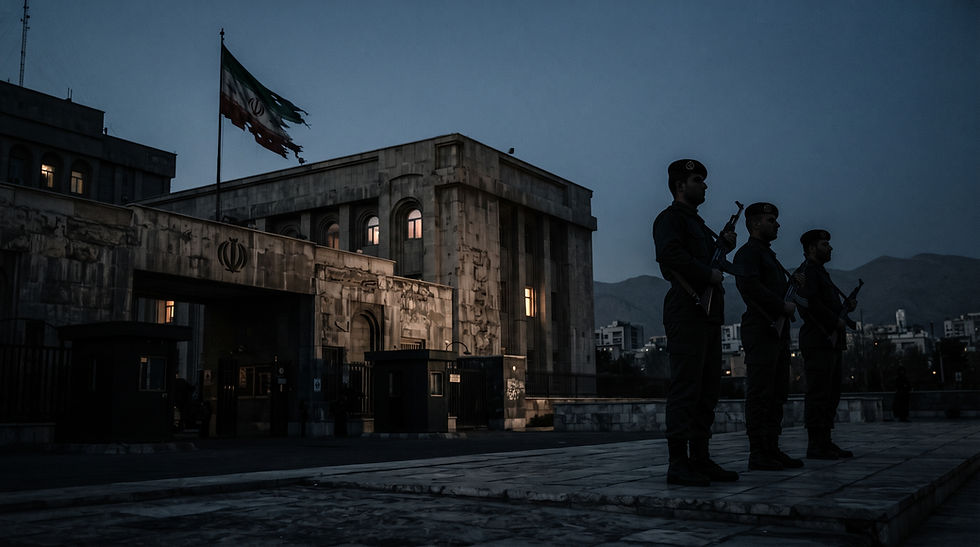
For years, a recurring assumption in Western and Israeli discussions of Iran held that the Islamic Republic was extraordinarily dependent on one man. Remove the Supreme Leader, the argument went, and the political system built around him might begin to unravel. On February 28, 2026, that theory was subjected to the most dramatic test imaginable when Ali Khamenei was killed in the opening stages of the war. The regime suffered an enormous shock and lost senior political, military and security figures. Yet the Islamic Republic did not collapse.
Instead, the system adapted. Within days, Mojtaba Khamenei was selected to succeed his father as Supreme Leader, preserving the office even as Iran remained at war. More importantly, the institutions beneath that office survived. Iran's security apparatus, missile forces, intelligence networks and Islamic Revolutionary Guard Corps remained in place. The upheaval therefore reinforced a reality that had been developing for decades: Iran is increasingly difficult to understand simply as a clerical theocracy centered on a single supreme religious figure. It has evolved into a hybrid military-security state in which the IRGC has become one of the principal guardians of political power, economic privilege and regime survival.
An Arab source familiar with regional security assessments told Middle East 24 that officials in several countries have increasingly begun describing Iran not merely as the “Islamic Republic,” but as an “IRGC Republic.” The phrase is provocative, but it captures an important transformation. The Supreme Leader and clerical establishment continue to provide the ideological and religious legitimacy of the Islamic Revolution. The Revolutionary Guards, however, increasingly provide much of the coercive, military and economic machinery required to preserve it. Understanding that distinction is essential not only to understanding how power works inside Iran, but also to understanding why U.S.-Iran negotiations have become so difficult.
How the IRGC Became a Center of Iranian Power
The Islamic Revolutionary Guard Corps was created after the 1979 revolution to defend the new political order against threats from within and abroad. Over the following four decades, however, the Guards expanded far beyond the functions of a conventional military. The IRGC developed its own intelligence structures, ballistic missile and drone programs, the Quds Force for operations beyond Iran's borders and close relationships with armed groups across the Middle East. At home, it became central to the state's ability to suppress dissent and defend the political system during periods of instability.
At the same time, the Revolutionary Guards developed a vast economic network. Their engineering conglomerate, Khatam al-Anbia, became involved in major construction, infrastructure and energy projects, while IRGC-linked entities established interests across strategically important sectors of the Iranian economy. The U.S. Treasury has described Khatam al-Anbia as an important economic arm of the IRGC. Although the exact scale of the Guards' economic influence is difficult to establish because of opaque ownership structures, the broader point is clear: the institutional interests of the IRGC have become deeply intertwined with the survival of the political order it is charged with protecting.
The events of 2026 have offered further evidence of how these financial networks operate. In May, the U.S. Treasury sanctioned an IRGC-linked network involved in selling Iranian oil to China, saying that the Guards used overseas front companies to obscure their role in oil sales and funnel revenues back into Iran. Treasury has also targeted wider shadow-banking and procurement systems used to move oil revenues and obtain military components. In July, the State Department announced additional sanctions against facilitators of IRGC weapons procurement. These are U.S. government assessments and should be understood as such, but they provide concrete examples of how the IRGC's military mission, foreign operations and economic interests overlap. This is what makes the Revolutionary Guards fundamentally different from a conventional national military. The IRGC does not merely defend the state from outside it. Its political influence, institutional power, commercial interests and ideological mission are bound to the continuation of the Islamic Republic itself. A fundamental transformation in Iran's military posture, regional strategy or relationship with the West could therefore affect not merely Iranian foreign policy, but the power of one of the country's most important institutions.
What Khamenei’s Death Revealed About the Iranian Regime
The death of Ali Khamenei did not prove that the Islamic Republic is invulnerable. Iran continues to face profound military, economic and political pressures, while disagreements within its ruling establishment remain significant. The Iranian system should not be treated as monolithic, and civilian politicians, clerics, technocrats and military commanders do not necessarily share identical priorities.
What Khamenei's death did demonstrate, however, is that removing the individual at the apex of the system is not the same thing as removing the system itself. Iran had developed political, military and security institutions capable of preserving continuity even after losing its Supreme Leader and numerous senior officials. Mojtaba Khamenei inherited the office, but beneath him remained an extensive state architecture with its own commanders, weapons, intelligence structures, financial networks and institutional interests.
Islamic Republic proved more resilient than the man who had stood at its center.
The growing prominence of IRGC commander Ahmad Vahidi provides one indication of how power shifted following the war. In May, the Associated Press reported that Vahidi had become a major figure in formulating Iran's negotiating position toward the United States, describing him as part of a small circle close to the new Supreme Leader. His prominence does not mean that the Revolutionary Guards have simply replaced Iran's clerical leadership or that a single commander controls Iranian policy. It does suggest, however, that understanding who possesses meaningful influence over war, nuclear policy and relations with Washington now requires looking beyond Iran's formal diplomatic and civilian institutions. citeturn521963news46
That distinction leads directly to one of Washington's most important problems in dealing with Iran: determining not merely who is prepared to negotiate, but who actually has the authority to deliver.
Why the IRGC Matters to U.S.-Iran Negotiations
Perhaps the clearest evidence of this problem emerged from the difficulties encountered by American negotiators themselves. According to Axios reporting published on August 16, U.S. officials attempting to negotiate an end to the war encountered an extraordinary problem in mid-May: they could not determine whether the Iranian officials negotiating with them actually spoke for the Revolutionary Guards. citeturn521963news42
The Trump administration therefore sought a separate backchannel to the IRGC leadership. According to the report, Washington used Nechirvan Barzani, president of Iraq's Kurdistan Region, as an intermediary capable of communicating with senior Guard officials. The purpose of the channel was revealing. American officials wanted to establish whether the institution controlling much of Iran's military power actually supported what Iranian political negotiators were discussing.
The episode does not demonstrate that Iran's diplomats are powerless. It reveals something subtler and potentially more consequential: an agreement reached with Iranian political officials may be insufficient unless the institutions capable of implementing or obstructing that agreement also accept it. For Washington, the question is therefore no longer simply whether Iran is prepared to sign an agreement. It is whether the officials signing that agreement can reliably commit the security establishment controlling many of the capabilities the United States is trying to constrain.
This is the practical meaning of the “IRGC Republic.” It is not simply a description of how many businesses the Guards control or how many missiles they possess. It is a question of where ultimate veto power resides when Iran must make decisions involving war, nuclear capabilities, regional proxies and accommodation with the United States.
How Iran Can Use Diplomacy to Preserve the Regime
This institutional reality also changes how Iranian diplomacy should be understood. Tehran's willingness to negotiate should not automatically be dismissed as deception. Iran contains competing political factions, and some officials undoubtedly regard accommodation with the United States as necessary to reduce economic pressure and prevent further military destruction. But diplomacy can serve multiple purposes simultaneously. It can represent a genuine attempt to avert conflict while also providing Iran with time, economic breathing room and an opportunity to preserve capabilities that the security establishment regards as essential to regime survival.
For the IRGC, those incentives are particularly powerful. A prolonged negotiating process can postpone military action, increase divisions among Western governments over whether further pressure is justified, create opportunities for sanctions relief and provide time to repair damaged networks or military capabilities. From Tehran's perspective, the value of diplomacy therefore does not necessarily depend upon achieving a comprehensive final settlement. A negotiating process that reduces immediate pressure while preserving the fundamental architecture of Iranian power can itself provide strategic value.
Recent developments illustrate how diplomacy and confrontation can operate simultaneously rather than sequentially. Even while U.S.-Iran negotiations and ceasefire arrangements have continued, Washington has imposed additional sanctions intended to disrupt IRGC weapons procurement networks and the financial systems supporting Iran's military. That overlap matters because negotiations should not be understood simply as the opposite of confrontation. For Tehran, both can form part of the same struggle over pressure, capabilities and survival. The danger is therefore not simply that Iranian officials might make promises they later break. The deeper problem is structural. Iran's military-security establishment has powerful incentives to obtain whatever economic and diplomatic breathing room negotiations can provide without surrendering the capabilities on which its strategic influence and institutional power depend.
Why Real Iranian Concessions Are So Difficult
This helps explain why the most consequential Western demands are also the most difficult for Tehran to accept. Severely limiting uranium enrichment, surrendering missile and drone capabilities, dismantling relationships with regional armed groups or accepting highly intrusive verification would not constitute ordinary diplomatic compromises. Each would affect an instrument that has provided the Islamic Republic and particularly the Revolutionary Guards with deterrence, regional influence or institutional power.
That does not mean diplomacy is pointless. The costs of continuing conflict make negotiations potentially essential. But it does mean that Western governments must distinguish carefully between Iranian commitments and measurable changes in Iranian capabilities. The durability of any agreement will depend less on declarations of intent than on verification, sequencing and enforcement. Sanctions relief should correspond to demonstrated implementation; restrictions should focus on capabilities rather than rhetoric; and violations should carry clear consequences that do not require years of renewed diplomatic bargaining. Washington must also ask a question that has become much harder to ignore: who inside Iran can actually guarantee implementation?
If the Revolutionary Guards exercise decisive influence over missile programs, military procurement, regional operations and national-security decisions, then an agreement that lacks their institutional acceptance may be inherently fragile. The fact that American officials reportedly sought a separate backchannel simply to determine whether the IRGC supported Iran's negotiators demonstrates how important this question has become.
The Myth of the “Day After” Khamenei
Ali Khamenei's death should therefore force a reassessment of how outsiders think about political change in Iran. The Islamic Republic was never simply a dictatorship built around one aging cleric. Over decades it constructed overlapping political, religious, military, intelligence and economic institutions designed to protect the revolutionary system. The Supreme Leader stood at the apex of that structure, but he was not the structure itself.
The clerical establishment continues to matter enormously. Mojtaba Khamenei's succession demonstrates the regime's determination to preserve the religious architecture of the Islamic Republic, while political factions continue competing for influence around the Supreme Leader. Yet the IRGC possesses a different form of power: coercive capacity, organized manpower, military capabilities, intelligence infrastructure and extensive economic networks. In periods of extreme instability, these assets can become decisive to the survival of the regime. Describing Iran as an emerging “IRGC Republic” therefore does not mean clerical rule has disappeared, or that every branch of the Iranian government takes orders from the Revolutionary Guards. It means the IRGC has become so deeply embedded in the state's ability to defend itself, finance itself and project power that no serious strategy toward Iran can ignore the institutional interests of the Guards.
Negotiating With the Iran That Actually Exists
Washington should continue negotiating when diplomacy can reduce the danger of war, constrain Iran's nuclear program or produce enforceable security arrangements. But it should negotiate with a realistic understanding of the government on the other side of the table. Iran is not a conventional political system in which civilian ministers necessarily exercise uncontested control over national security. Nor is it simply a one-man dictatorship whose political order disappears when its leader is removed.
The challenge is therefore not to reject diplomacy, but to make diplomacy reflect the actual distribution of power inside Iran. Any durable agreement must be verifiable, tied to measurable changes in capabilities and structured so that economic relief depends on implementation. Above all, Washington must know whether the people making commitments can bind the institutions with the power to violate them.
The events of 2026 have made that question impossible to ignore. Ali Khamenei was killed, but the Islamic Republic survived. His son inherited the office while the Revolutionary Guards remained embedded throughout Iran's military, economic and security machinery. Months later, American officials reportedly found themselves trying to determine whether Iran's own negotiators could speak for the Guards. That sequence tells us more about the future of the Islamic Republic than any simplistic theory of regime decapitation. The fundamental question is no longer merely who sits in the Supreme Leader's office, but who controls the machinery of power beneath it — and whether any agreement with Tehran can constrain those who do.
Moataz Khalil is an Egyptian, London-based journalist and media researcher specializing in Iran and Middle East affairs. He is a senior contributor to Middle East 24 and MidEast.Journal and has written for media platforms across the Middle East.