Lebanon’s Christians Need a Future Beyond Perpetual War

By Tony Boulos
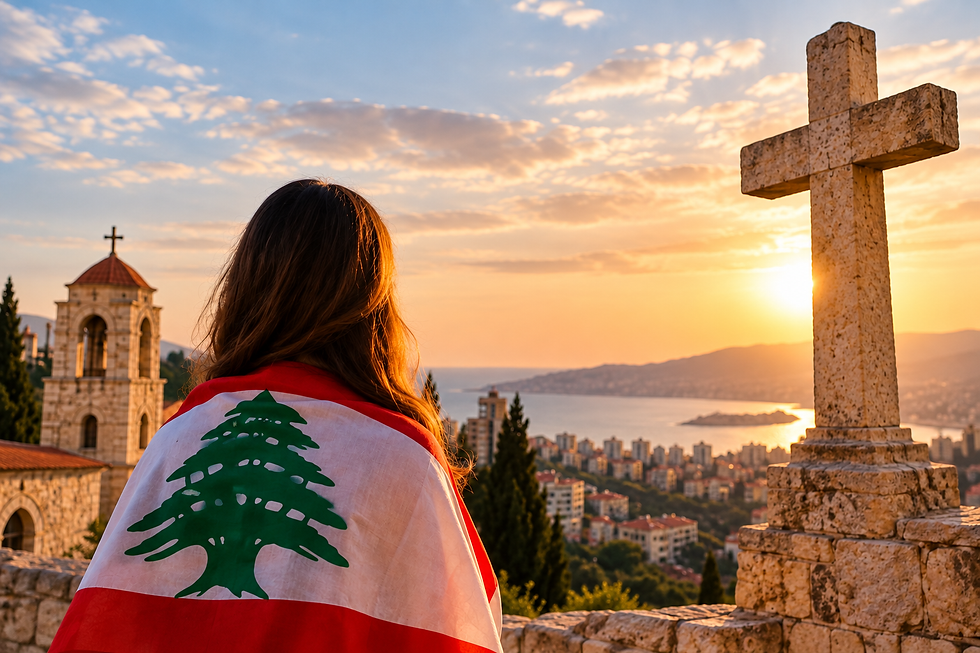
Lebanon’s Christians face a crisis that goes well beyond their declining share of the population. They fear remaining in a country whose future they can no longer shape, where the founding promise of partnership has been reduced to seats and offices in a system controlled by others. When representation ceases to confer a meaningful say, an existential question follows: what does it mean to stay when freedom is threatened, the economy has collapsed and the decision to go to war lies beyond the reach of both citizens and the state?
Demography and Political Power in Lebanon
That demographic anxiety is real, but the figures require care. Lebanon has held no comprehensive official census since 1932, and the relative decline of its Christian population began decades before the 1990s. A 2026 demographic study by Lebanese University researcher Chawki Attieh underscores how difficult it is to establish precise population figures in a country with outdated official data, large-scale migration and major differences between citizens, residents and registered voters.
Frequently cited estimates placing Christians at roughly one-third of Lebanon’s population often rely on electoral rolls rather than a resident census. Interior Ministry electoral lists published in 2022, for example, showed Christians making up about 33.9 percent of registered voters. That figure describes the electorate, including Lebanese abroad; it should not be confused with the Christian share of everyone currently living on Lebanese territory.
The decline reflects the combined effects of fertility, emigration and an aging population. Differences in birth rates between communities matter, but they also respond to education, income, marriage patterns and broader social change. Emigration, meanwhile, is something political choices can accelerate or slow. Successive waves have followed war, displacement, foreign domination and economic crises, culminating in the financial collapse that began in 2019. The World Bank has described Lebanon’s crisis as potentially one of the most severe economic collapses globally since the mid-19th century, accompanied by an accelerating loss of skilled human capital.
This is where demographic decline becomes political. A young person who leaves in search of security and work will not return because of a speech about ancestral roots. Returning requires courts that offer protection, institutions that allow advancement and an economy in which a future can be built. A community can retain its land, churches and collective memory while losing its capacity to renew itself. The deepest danger is that the homeland survives as an emotional attachment while the future takes shape elsewhere.
The distinctiveness of Lebanon’s Christians lies not merely in their numbers, but in their role in founding the state, shaping its identity and building its institutions, as well as in the constitutional power-sharing arrangement that distinguishes their experience from that of other Christian communities in the region. For them, freedom has historically included participating in government, running institutions, contributing to cultural and economic life, and challenging those in power. These are rights all Lebanese need. Their erosion, however, threatens the very meaning of the Lebanese experience to which the Christian community’s continued presence has been tied.
In Iraq and Syria, war, persecution and economic collapse have driven large numbers of Christians abroad. Both countries also expose the limits of protection offered by regimes or militias: a community’s fate becomes tied to that of its protector even as citizenship and public institutions erode. Once extremist organizations, armed factions and war economies dominate political life, the space for independent civic life contracts. A community can therefore continue to shrink even after the immediate military threat recedes because the conditions for normal life never fully return.
The Legacy of Foreign Domination
Understanding Lebanon’s crisis requires distinguishing the Taif Agreement from the way it was implemented. The 1989 Taif Agreement redistributed executive authority and reduced the powers of the Maronite presidency, but it also enshrined equal parliamentary representation for Christians and Muslims. To portray Taif simply as a blueprint for Christian marginalization therefore overlooks safeguards that remain central to Christian political participation.
The deeper problem was the political order that emerged under Syrian domination after the civil war. Damascus maintained a military and intelligence presence and exercised extensive influence over Lebanese politics throughout the 1990s and early 2000s. Michel Aoun went into exile, Samir Geagea was imprisoned and major anti-Syrian Christian political forces were marginalized, even as Christian politicians allied with Damascus remained in office. Institutional representation survived, but political independence suffered.
Syria’s withdrawal in 2005 created an opportunity to restore sovereignty. Hezbollah, however, possessed military capabilities independent of the Lebanese state and, backed by Iran, accumulated influence far beyond its parliamentary representation. Lebanon gradually moved from direct Syrian domination toward a political system in which strategic questions of war and peace could still be decided outside state institutions.
Any reckoning with that history must also hold Christian leaders accountable.
The 2006 Mar Mikhael agreement between Michel Aoun’s Free Patriotic Movement and Hezbollah gave the latter substantial Christian political cover, tying the pursuit of renewed Christian influence to an alliance with its armed power. Yet access to the highest offices did not restore the state’s authority over national decisions. The experience demonstrated that a leader’s political gains can coincide with the weakening of the institutions on which his community ultimately depends. Holding the presidency is no substitute for sovereignty.
Today’s opportunity for change rests on a markedly different regional balance. Hezbollah suffered serious military losses, while the fall of Bashar al-Assad severed a crucial Syrian route through which Iran had supplied the organization. Hezbollah itself acknowledged the loss of that supply line. The subsequent election of Joseph Aoun as president and designation of Nawaf Salam as prime minister in January 2025 reflected a significant shift in Lebanon’s internal balance of power.
But a weaker Hezbollah does not automatically produce a stronger state. An armed organization can lose military capacity while retaining political power and the ability to obstruct. The old political establishment can also exploit change simply to redistribute offices and patronage, leaving the interests of citizens largely unchanged.
This explains the hesitation among many Christians. They fear both a status quo that steadily erodes their presence and a new political settlement that could strip away their remaining safeguards. Renegotiating the national compact under armed pressure or during economic collapse could benefit whichever faction remains best organized and most capable of coercion. Yet indefinitely postponing the debate allows emigration and demographic decline to continue. The question is therefore not only what should change, but how political partnership and individual rights will be protected during that transition.
Federalism and the Sovereignty Test
Federalism deserves serious discussion as a constitutional means of distributing power, strengthening local government and accountability, and reducing competition for control of the center. Its supporters ask a legitimate question: why should development, services and local spending remain hostage to stalled national bargains?
But federalism also requires difficult answers. Where would federal boundaries lie? How would minorities living within each unit be protected? What happens to mixed communities? How would Lebanon divide public debt, national resources and infrastructure? Neat lines on a map cannot resolve the complexities of a country whose populations and economic interests remain deeply intertwined.
Above all, federalism does not eliminate the sovereignty problem. If a political party retains an independent army and military relationship with a foreign power, internal administrative boundaries cannot shield the rest of the country from the consequences of war. The airport, ports, investment climate, currency and public security all remain exposed to decisions made outside constitutional institutions.
Federalism, like any other system, therefore requires a legitimate state with control over armed force and foreign relations. Otherwise, decentralization risks entrenching territories controlled by competing armed or sectarian factions rather than creating a constitutional federation that protects citizens.
Reform can also begin within the existing framework. Taif itself calls for expanded administrative decentralization, while Article 22 of the Lebanese Constitution provides for the eventual creation of a senate representing Lebanon’s religious communities alongside a parliament elected on a national, non-sectarian basis. Judicial independence and mechanisms to prevent institutional paralysis can also be strengthened without immediately dismantling the constitutional order. These options require safeguards and consensus, but they demonstrate that Lebanon’s choices extend beyond preserving a failed status quo or overturning the entire political system.
The Case for Peace
The sovereignty debate inevitably reaches Lebanon’s relationship with Israel, because deciding who has the authority to make war also requires deciding who has the authority to end it.
The political environment has changed significantly. An Information International survey conducted between April 28 and May 5, 2026 among 2,000 Lebanese respondents found that 48.9 percent accepted the idea of the president and government signing a peace agreement with Israel, while 46 percent opposed it. Among Maronites, support reached 76.5 percent; among Greek Orthodox respondents, 72.2 percent. Those numbers suggest substantial Christian support for peace, although they do not establish either a universal Christian consensus or an overwhelming national majority.
The distinction between peace and normalization is equally important. The same survey found only 30.4 percent national support for normalization with Israel, compared with 59.3 percent opposition. More Lebanese appear prepared to contemplate formally ending conflict than embracing full political, economic and cultural relations.
That distinction matters. Ending the conflict has become a subject of public debate after decades in which it was largely treated as taboo. The recently negotiated Lebanon-Israel framework has similarly pushed questions of sovereignty, security and a possible future peace agreement into the political mainstream; MidEast Journal has examined that framework and its implications for Lebanese sovereignty in detail.
The strongest Lebanese argument for peace begins with the population’s right to prevent the country from repeatedly becoming a battleground for regional agendas. From Palestinian armed organizations during the civil-war era to Hezbollah’s relationship with Iran, Lebanon has repeatedly faced situations in which armed actors made strategic decisions whose consequences extended far beyond their own constituencies. Whatever one’s view of those conflicts, decisions about war and foreign policy should ultimately answer to Lebanon’s constitutional institutions and national interest.
Peace also cannot mean simply shifting responsibility from one armed actor to another. Any lasting settlement must address Israeli withdrawal, border security, civilian protection and respect for Lebanese sovereignty, with mechanisms requiring commitments from both sides. Opposition to Hezbollah’s independent arsenal does not absolve Israel of responsibility for its own actions or violations. A viable peace would have to protect Lebanon rather than substitute one form of insecurity for another.
Building a Future at Home
Peace and sovereignty matter in part because Lebanon’s demographic crisis cannot be separated from its economic one. Greater stability could reduce political risk and create opportunities in trade, tourism, technology and investment, but those benefits will remain theoretical without financial, judicial and institutional reform.
An economy based on knowledge, services and production requires clear rules and lasting confidence. Smuggling, patronage and informal political networks thrive when the state remains weak. Rebuilding a productive economy is therefore integral to sustaining Lebanon’s Christian presence, but it is equally important for every Lebanese community whose young people increasingly face the same choice: leave or depend on a political network for access to jobs, services and security.
Christian aspirations are most sustainable when they form part of a national project that guarantees participation, freedom and economic opportunity for every citizen. That includes the right of Shia Lebanese to full political participation and security without being reduced to Hezbollah or held collectively responsible for its decisions.
Ending armed domination should therefore mean ending the political privilege created by weapons while preserving political equality. Any future settlement that rewards an armed faction with additional constitutional privileges simply in exchange for relinquishing its arsenal would create a dangerous precedent: coercive power could later be converted into political rights.
Lebanon’s Christians now have an opportunity to regain political initiative, but doing so requires moving beyond competition for offices and tying their future to the reconstruction of the state itself.
The real measure of success will not be how many ministries, parliamentary seats or senior positions a community controls. It will be whether its young people can remain in Lebanon, whether citizens can build careers without political patronage, whether the country can decide for itself when it goes to war and when it makes peace, and whether families can build lives they do not expect the next conflict to destroy.
Federalism, decentralization and every other constitutional proposal should ultimately be judged against those outcomes. Lebanon’s deeper challenge is to stop serving as a battleground for others and become a country capable of governing itself, living in peace and giving its people a reason to stay.
Tony Boulos is a Lebanese journalist and political analyst specializing in Middle East security and geopolitics. He is a senior contributor to MiddleEast24 and MidEast.Journal.