Trump's Turkey Gamble: Should NATO Let Ankara Back Into the F-35 Program?
- Dr. Marios P. Efthymiopoulos
- Jul 10
- 3 min read
Updated: Jul 13
As President Trump considers easing sanctions on Turkey and restoring access to the F-35, NATO faces a defining test of alliance trust, regional security, and strategic credibility.
By Dr. Marios P. Efthymiopoulos
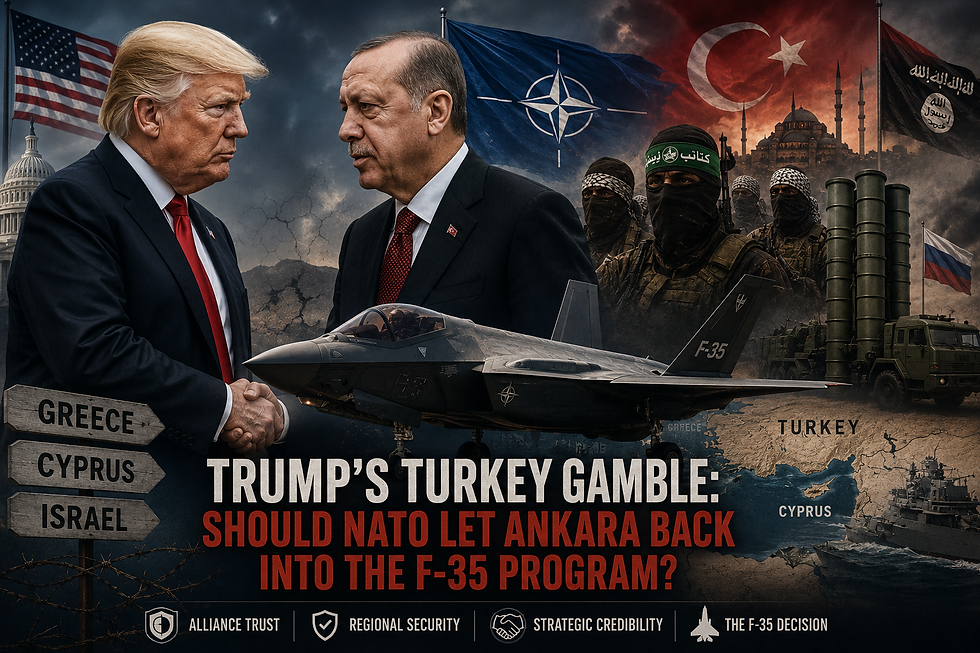
President Donald Trump's visit to Turkey has reignited one of the most consequential strategic debates facing NATO. Reports that Washington is considering easing CAATSA sanctions and allowing Ankara back into the F-35 fighter program would mark one of the biggest shifts in U.S.-Turkey defense relations in years.
But this debate is about far more than fighter jets.
It comes as Turkey continues to pursue an increasingly independent foreign policy, maintain close ties with Hamas, escalate hostile rhetoric toward Israel, and remain locked in disputes with fellow NATO members Greece and Cyprus. The question confronting Washington is therefore much larger: should NATO restore access to its most advanced military technology based primarily on Turkey's geopolitical importance, or should those privileges depend on strategic trust, responsible behavior, and alliance cohesion?
Why Turkey Still Matters to NATO
Turkey remains one of NATO's most strategically important members. Its geography places it at the crossroads of Europe, the Black Sea, the Caucasus, and the Middle East, giving it a central role in the Alliance's posture toward Russia, Iran, Syria, and regional instability.
Its importance is not in question.
What is in question is whether geography alone should outweigh strategic consistency. Access to advanced military technology, intelligence sharing, missile defense integration, and defense-industrial cooperation should remain linked to responsible conduct and confidence among allies. Strategic importance should open the door to dialogue—not automatically restore access to NATO's most sensitive military capabilities.
Why the F-35 Debate Is Really About Trust
Turkey was removed from the F-35 program after purchasing Russia's S-400 air defense system despite repeated warnings from the United States and other NATO allies. The decision reflected serious concerns about technology security, intelligence protection, and NATO interoperability—not political symbolism.
Those concerns remain.
The F-35 is not simply another fighter aircraft. It is among the most sophisticated weapons systems in the Western arsenal, integrating stealth, intelligence, communications, and battlefield networking. Access requires more than military capability; it requires confidence that the recipient fully supports NATO's collective security interests.
That confidence has been weakened over the past decade.
Greece continues to face the Turkish Parliament's 1995 casus belli over the Aegean, while Cyprus remains divided with Turkish forces stationed in the island's north. These disputes continue to undermine confidence within the Alliance and shape how many allies assess Turkey's long-term strategic reliability.
Turkey, Hamas, and a Changing Regional Balance
The strategic landscape has also changed dramatically.
Since the regional confrontation with Iran, Israel has emerged as an even more central U.S. security partner in the Middle East, while Greece and Cyprus have become increasingly important pillars of stability on NATO's southeastern flank. Their growing cooperation on defense, intelligence, energy security, and critical infrastructure reflects a broader shift in the Eastern Mediterranean's strategic balance.
Against that backdrop, Turkey's close relationship with Hamas and the increasingly hostile rhetoric toward Israel from President Recep Tayyip Erdoğan and Foreign Minister Hakan Fidan have deepened concerns in Washington, Jerusalem, Athens, and other allied capitals. Political support for a U.S.-designated terrorist organization and sustained attacks on one of America's closest regional partners inevitably influence assessments of strategic trust.
Israel's concerns about any future transfer of advanced military capabilities to Turkey therefore extend beyond bilateral tensions. They touch directly on regional deterrence, intelligence security, and preserving the military balance that has long underpinned U.S. policy in the Middle East.
Strategic Conditionality Is Not Exclusion
None of this argues for excluding Turkey from NATO.
On the contrary, the Alliance should seek Turkey's full strategic realignment. But restored defense cooperation, sanctions relief, intelligence integration, and renewed access to advanced American military technology should follow clear and verifiable changes in Turkish policy—not precede them.
That includes resolving the S-400 issue, reducing coercive behavior toward fellow allies, improving relations with Israel, respecting international law, and demonstrating a sustained commitment to NATO's collective security objectives.
Removing CAATSA sanctions without measurable change would weaken Western leverage, diminish deterrence, and create a dangerous precedent for the Alliance.
Ultimately, the question is not whether Turkey belongs in NATO. It does.
The real question is whether NATO is prepared to uphold the principles that have made the Alliance successful for more than seven decades. President Trump's effort to rebuild relations with Ankara may create new diplomatic opportunities, but diplomacy should not come at the expense of alliance credibility. Strategic importance is undeniable—but it cannot become a substitute for strategic trust.
If Turkey wishes to regain access to NATO's most advanced military technologies, it should first demonstrate that it is prepared to uphold the responsibilities those technol
ogies are designed to defend.
Dr. Marios Efthymiopoulos is the Director of Strategy International (SI)
Research Professor at Vytautas Magnus University school of Politics and Diplomacy in Kaunas Lithuania