ME24 Exclusive Investigation: Inside Hamas Funding Networks in Europe — A Rare Look at Hamas' Money Laundering Mechanisms

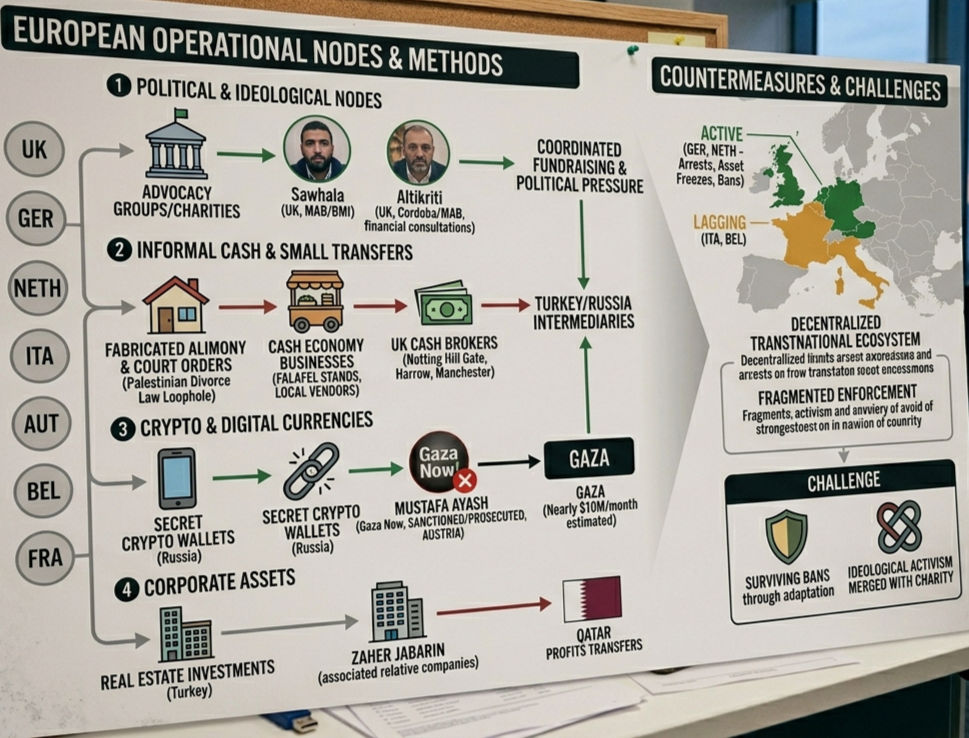
Despite terror bans across Europe, Hamas-linked financial and ideological networks continue operating through charities, cryptocurrency channels, advocacy groups, informal cash businesses, and underground transfer systems. Europe must get serious on these if it actually seeks to halt the flow of cash from Europe to Hamas’ terrorist operations
By Moataz Khalil
While many European governments officially designate Hamas as a terrorist organization and prohibit its political activity, the group’s financial and logistical networks continue to evolve across Europe.
Security experts and regional analysts warn that Hamas — designated as a terrorist organization by the United States, the European Union, Britain, and several Arab governments — has adapted to Western counterterrorism restrictions through decentralized financial and ideological support systems that are harder to monitor and dismantle.
Investigators and regional sources describe an ecosystem stretching from charities and cryptocurrency wallets to informal cash businesses, including falafel stands and mobile food vendors operating across Europe.
Hamas’ Ban in Britain and Its Implications
In November 2021, Britain formally designated Hamas in its entirety as a terrorist organization, extending the ban to include its political wing alongside the Izz ad-Din al-Qassam Brigades, Hamas’ military arm, which had already been blacklisted for nearly two decades.
Despite the designation, financial and organizational systems linked to Hamas have continued operating across Britain and parts of Europe through charities, advocacy organizations, business figures, and informal ideological networks.
Analysts argue that while European governments have tightened legal restrictions on Hamas, enforcement remains fragmented across jurisdictions, allowing support structures to adapt rather than disappear.
How Hamas Raises Money Inside Europe
According to former American officials and security assessments, Hamas-linked financing networks generate millions of dollars annually through charities, informal cash systems, cryptocurrency transfers, business investments, and decentralized fundraising operations operating partly inside Europe.
Among the figures frequently cited in media and security reports is Mohammed Sawalha, a former Hamas figure from the West Bank who later moved to Britain.
Sawalha has been linked to several Muslim advocacy organizations in the United Kingdom, including the Muslim Association of Britain, and has repeatedly appeared in public reporting connected to fundraising activity and political coordination tied to pro-Hamas networks.
A security report highlighted by The Telegraph warned that Hamas was exploiting humanitarian work to channel donations into Gaza through charities, online campaigns, and cryptocurrency transfers.
Another prominent figure is Iraqi Islamist activist Anas Altikriti, one of the directors of the Muslim Association of Britain and head of the Cordoba Foundation. Altikriti co-founded the British Muslim Initiative alongside Mohammed Sawalha and Azzam Tamimi, who has been described as Hamas’ “special envoy” in Britain.
Although Altikriti appears more removed from Hamas’ direct financial operations, sources previously described him as providing consultations to Palestinians seeking ways to transfer money from Ireland to Gaza without violating European law.
Small Transfers and Informal Financial Channels
An exclusive source told ME24 that the European money-transfer system into Gaza relies on two primary channels: continuous small transfers and larger financial operations.
According to the source, one mechanism involves exploiting personal status laws involving divorced Palestinian women. Individuals allegedly present rulings from Palestinian courts ordering monthly support payments to former spouses, allowing funds to move regularly under humanitarian or family-support claims. The source claimed some of these cases are fabricated and that divorce and alimony documents are occasionally issued solely to facilitate transfers that ultimately benefit Hamas.
ME24’s investigation revealed that humanitarian organizations, shelters, mosques, and religious institutions in Gaza are sometimes used as conduits for financial transfers. According to the source, some Palestinians holding British citizenship send money under claims that they are supporting orphaned relatives or educational expenses, while some organizations allegedly function as covert financial channels moving money into Gaza under humanitarian cover.
How Hamas Funding Reaches Europe Through Charities and Crypto
According to Palestinian sources speaking to ME24, one method used to send assistance to Gaza involves Palestinian-owned food businesses, particularly mobile falafel stands and restaurants.
Britain and several European countries have imposed strict restrictions on transferring money into the Palestinian territories, limiting transactions to monitored banking systems and financial platforms subject to Israeli oversight. However, according to the source, some individuals exploit loopholes involving cash-heavy businesses. The source alleged that portions of this cash are transferred to money brokers operating in areas such as Notting Hill Gate, Harrow, and Manchester before being routed through intermediaries in Turkey or Russia and eventually reaching Gaza.
According to the source, one transfer method involve
s financial applications used in the West Bank, where funds are redirected into accounts controlled by individuals specializing in transferring money to Hamas-linked entities.
This investigation traces how Hamas funding reaches Europe through a web of charities, crypto wallets, and cash couriers.
Large Transfers and Real Estate Investments
An Arab source in London told ME24 that another major funding stream allegedly operates through Turkey and involves Hamas figure Zaher Jabarin, who has been associated with real estate investments. According to the source, properties are allegedly sold through a company connected to Jabarin’s relatives, with portions of the profits transferred through Qatar before eventually reaching Gaza.
Security analysts warn that such international business structures complicate terror-financing investigations because financial activity often overlaps with legitimate commercial operations.
Cryptocurrency and Hamas Financing Networks
Former American officials previously estimated in a security assessment paper that Hamas receives nearly $10 million per month through donations and financing systems operating partly through Europe. The fundraising structure reportedly relies heavily on charities, financial intermediaries, and cryptocurrency systems designed to conceal the destination of funds.
Several organizations have been banned, including “Gaza Now” and its founder Mustafa Ayash, who resides in Europe. Ayash was placed under U.S. sanctions after American and European authorities accused him of facilitating financial support for Hamas through online fundraising campaigns.
Investigations later revealed the use of both traditional banking systems and cryptocurrency accounts. Austrian authorities subsequently launched legal proceedings against Ayash on terrorism-financing charges. Over recent years, the U.S. Treasury Department has also imposed sanctions on multiple European entities accused of acting as financial fronts for Hamas, including organizations operating in Italy, Austria, and Belgium.
Europe’s Uneven Response
Despite growing concern and increasingly strict counterterrorism laws, Europe’s response has remained uneven. Germany and the Netherlands have taken relatively aggressive measures against Hamas-linked financing structures, including arrests, sanctions enforcement, and investigations into fundraising operations. Critics argue, however, that other governments — including Belgium and Italy — have moved too slowly despite repeated warnings from allied intelligence agencies.
Another Palestinian source pointed to cryptocurrency operations tied to Gaza, claiming that digital funds are often routed through secret cryptocurrency wallets based primarily in Russia.
European Countermeasures and the Muslim Brotherhood Connection
In 2024, French authorities froze the assets of a France-based NGO after reports indicated that Israeli forces discovered materials bearing the organization’s logo inside Hamas tunnels in Gaza. U.S. authorities later identified the organization as an alias connected to a charity previously sanctioned more than two decades ago for financing Hamas. Security experts increasingly argue that Europe’s challenge is no longer limited to isolated extremist financing cases. Instead, they warn of a broad transnational infrastructure where ideological activism, charitable fundraising, political lobbying, media influence, and informal financial systems intersect in ways that enable support for Hamas despite formal bans.
Recent European investigations have also highlighted growing concerns regarding overlap between Islamist organizations and networks associated with the Muslim Brotherhood.
Conclusion
As European governments intensify scrutiny of extremist financing networks following the Gaza war, Hamas-linked infrastructures operating across Europe are likely to face increasing political and legal pressure. Yet security experts warn that the decentralized nature of these networks — blending ideological activism, humanitarian fundraising, cryptocurrency systems, and informal cash economies — makes them exceptionally difficult to dismantle completely.
The broader challenge for Europe, analysts argue, is no longer simply identifying isolated terror-financing operations, but confronting adaptive transnational ecosystems capable of surviving sanctions, bans, and evolving counterterrorism measures.
Moataz AlKhalil is an Egyptian, London-based journalist and media researcher on Middle East affairs. He is a senior contributor to MiddleEast24 and has written for many of the top media platforms across the Middle East.