Have the Abraham Accords Become a National Necessity for Sudan?Sudan’s Future Series – Part I
By Dr. Tayseer Mustafa
After more than three years of war, the question occupying the minds of ordinary Sudanese is no longer who was right and who was wrong. For the citizen who has lost a home, a livelihood, or a loved one, the priorities are far more immediate: security, stability, and a genuine opportunity to return to normal life.
The war has inflicted devastating damage on Sudan’s people, economy, and state institutions, setting the country back by many years. The challenge is no longer limited to ending the fighting. It now encompasses rebuilding the economy, restoring confidence, attracting investment, creating jobs, and renewing hope for millions of Sudanese.
In these extraordinary circumstances, it is our national responsibility to reconsider every option that could help Sudan emerge from its crisis, free from preconceived judgments and political polarization. Countries recovering from devastating wars cannot rebuild themselves using yesterday’s tools alone. They must reassess their policies, broaden their options, and seek new partnerships that serve their national interests.
Among the issues that deserve careful and responsible reconsideration are the Abraham Accords. For years, this subject has been dominated by political controversy and often reduced to interpretations that fail to reflect either its full objectives or its broader potential.
Some have viewed the Accords simply as normalization with Israel. Others have portrayed them as a project directed against the Palestinian cause, while still others have associated them with religious concepts that bear little relation to their practical purpose. None of these interpretations captures the full picture.
At their core, the Abraham Accords provide a framework for cooperation among states in areas such as economic development, investment, agriculture, water management, healthcare, education, technology, energy, and innovation. They are founded on the principle that building shared interests can become one pathway toward greater stability, peace, and mutual prosperity for nations and their peoples. Raising this issue does not diminish the importance of the Palestinian cause, which continues to hold a profound place in the hearts of the Sudanese people and the wider Arab world. Rather, it raises a legitimate question shaped by Sudan’s current reality: after everything the country has endured, can Sudan afford to close the door on any opportunity that might contribute to rebuilding its economy, expanding its international partnerships, and strengthening the prospects for peace?
This is the question that deserves to be discussed today with an open mind and through one guiding principle alone: the interests of Sudan, the peace and security of its people, and the future of generations to come.
Some may argue that any discussion of the Abraham Accords should be postponed until after the war has ended, and that the sole priority today should be achieving a ceasefire. Yet the reality may be more complex. If the Accords have the potential to create regional and international partnerships, mobilize political, economic, and developmental resources, and encourage constructive engagement, then it is entirely legitimate to ask whether they could become part of the solution rather than merely a framework for the post-war period.
Waiting until the fighting has ended before considering such options may mean missing opportunities that could help narrow differences, strengthen peace efforts, and lay the foundations for a more sustainable settlement. Discussing the Abraham Accords today does not mean diverting attention from the urgent need to end the war. Rather, it raises the possibility that these partnerships themselves could become one of the instruments that help bring the conflict to an end—not only rebuild Sudan afterward.
How the Abraham Accords could contribute to efforts to end the war and build a sustainable peace in Sudan will be explored in greater detail in the next article.
Sudan Should View the Abraham Accords as a Regional Framework, Not a Bilateral Relationship
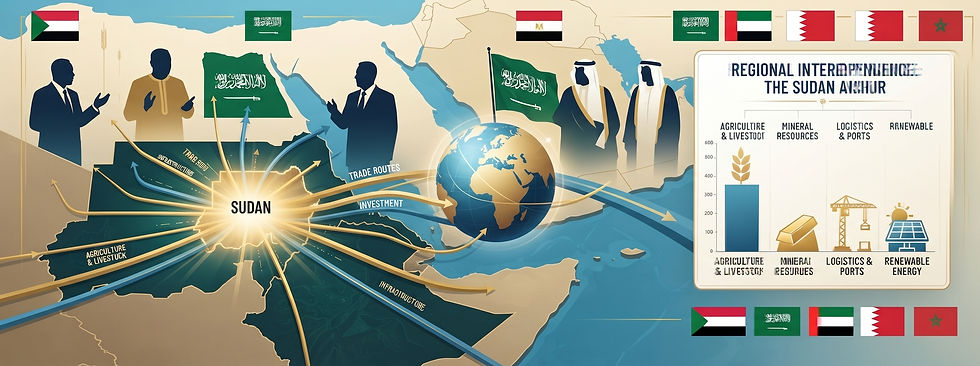
Sudan should not view the Abraham Accords simply as a relationship with one country. Rather, they should be understood as a gateway to a broader regional framework built on peaceful coexistence, investment, innovation, technology, economic cooperation, and sustainable development.
The Abraham Accords framework brings together Israel and several Arab states, including the United Arab Emirates, Bahrain, and Morocco, with the United States playing a central diplomatic and strategic role. Each of these countries possesses distinct strengths that, if approached through a clear Sudanese national strategy, could offer valuable opportunities for supporting a truce, advancing the peace process, addressing humanitarian challenges, and contributing to mid- and post-war recovery and long-term development.
The United Arab Emirates has established itself as one of the world’s leading hubs for investment, logistics, aviation, ports, infrastructure development, and innovation. Its experience in building modern economic ecosystems and attracting global capital could offer valuable lessons and partnership opportunities for Sudan as it seeks to rebuild its economy.
Bahrain brings considerable expertise in financial services, banking, regulatory reform, and modern economic legislation. Its experience in creating an internationally competitive financial sector could support Sudan’s efforts to strengthen its financial institutions and investment environment.
Morocco has developed significant expertise in modern agriculture, water-resource management, renewable energy, agro-industrial development, and regional trade. Its strategic position as a bridge between Africa and Europe also provides valuable experience in expanding market access and economic integration.
Israel is internationally recognized for its leadership in technology, innovation, smart agriculture, water management, irrigation systems, desalination, medical technologies, and cybersecurity. These are sectors likely to become increasingly important as Sudan rebuilds its infrastructure and economy. Sudan, in turn, possesses significant mineral resources, including gold and other strategic minerals that could become increasingly important in an era shaped by artificial intelligence, advanced computing, and high-technology manufacturing.
The United States remains one of the world’s leading sources of technological innovation, higher education, scientific research, investment, entrepreneurship, and access to global financial and commercial markets.
At the same time, Sudan does not enter such partnerships as a passive recipient of assistance. It enters as a country possessing significant strategic assets of its own.
Sudan is endowed with vast agricultural land, abundant natural resources, substantial livestock and mineral wealth, and a unique geographical position connecting Sub-Saharan Africa, the Arab world, and the Red Sea. Above all, it possesses a resilient and capable population whose greatest potential can be realized when given peace, opportunity, and the right environment in which to thrive.
From this perspective, any relationship built upon mutual respect, shared interests, and full respect for Sudan’s sovereignty should not be viewed as one between donor and recipient. Instead, it should be understood as a balanced partnership in which each side contributes its comparative strengths to create sustainable value and mutual benefit.
The central question, therefore, is not simply whether Sudan should engage with one country or another. It is whether Sudan can develop a foreign policy that places its national interests first, diversifies its international partnerships, and transforms its strategic assets into opportunities for peace, prosperity, and long-term stability. Ultimately, the value of any international partnership should be measured by its ability to improve the lives of Sudanese citizens, strengthen national sovereignty, expand economic opportunity, and contribute to a stable and prosperous future—not by political symbolism alone.
Why the Sudanese Citizen Must Become the Measure of Every National Decision
For decades, political debate in Sudan has often been shaped by ideology, regional alignments, and political rivalries. The current war, however, has fundamentally changed the national conversation .Today, the average Sudanese citizen is no longer concerned primarily with political slogans or competing narratives. People are asking far more urgent questions. They want to return to their homes, rebuild their lives, find employment, educate their children, access healthcare, and live in peace and security.
For this reason, every foreign-policy decision—and every regional or international partnership—should be evaluated through one simple but fundamental question:
Will this improve the lives of the Sudanese people? If a particular policy or partnership has the potential to contribute to ending the war, open new avenues for peace, attract investment, create employment opportunities, support reconstruction, transfer knowledge and technology, strengthen food security, and promote long-term stability, then it deserves serious and objective consideration, regardless of the political controversy surrounding it. In the aftermath of such a devastating conflict, the well-being of the Sudanese citizen must become the highest national priority. Conversely, if a proposal fails to advance the interests of the Sudanese people or undermines Sudan’s sovereignty and independent decision-making, then it should be rejected, regardless of the political arguments advanced in its favor. The national interest must become the compass that guides Sudan’s decisions—not political slogans or ideological divisions. After years of war and destruction, Sudan can no longer afford a foreign policy driven by polarization or emotional reactions. What the country needs is a pragmatic, balanced, and forward-looking approach that places the Sudanese citizen at the center of national decision-making.
The success of any foreign policy should not be measured by the number of agreements a country signs, but by its ability to improve the lives of its people, safeguard national interests, strengthen sovereignty, and build a more stable and prosperous future for generations to come. Nations are ultimately judged not by the slogans they proclaim, but by their ability to protect their people and secure their future. If Sudan is to rise from the devastation of war, it must have the courage to reassess all available options with an open mind. The interests of its citizens, the sovereignty of the state, and the aspirations of future generations must become the standard against which every policy and every international partnership is measured.
This is not a call for Sudan to align itself with any particular geopolitical bloc, nor is it a call to abandon long-held principles. Rather, it is a call for Sudan to become a confident, independent nation—one that engages with all partners from a position of dignity, mutual respect, and national interest, and uses its regional and international relationships to serve its people first and foremost. The purpose of this article is not to argue that the Abraham Accords are the only answer to Sudan’s challenges. Rather, it is to suggest that they deserve serious national discussion as one possible instrument among many.
In times of profound national crisis, no responsible nation can afford to dismiss credible opportunities without careful consideration. The question facing Sudan today is therefore not whether to preserve the debates of the past, but whether it possesses the vision and courage to explore every credible path that could help end the war, secure a lasting peace, rebuild Sudan, and create a more prosperous future for its people.