Did American Military Aid Build Israel's Security? The History Suggests Otherwise
- Dan Feferman

- Jun 23
- 7 min read
Vice President JD Vance's recent comments reignited a longstanding debate. But the historical record shows that American aid did not create Israel's military strength—it followed it.
By Dan Feferman
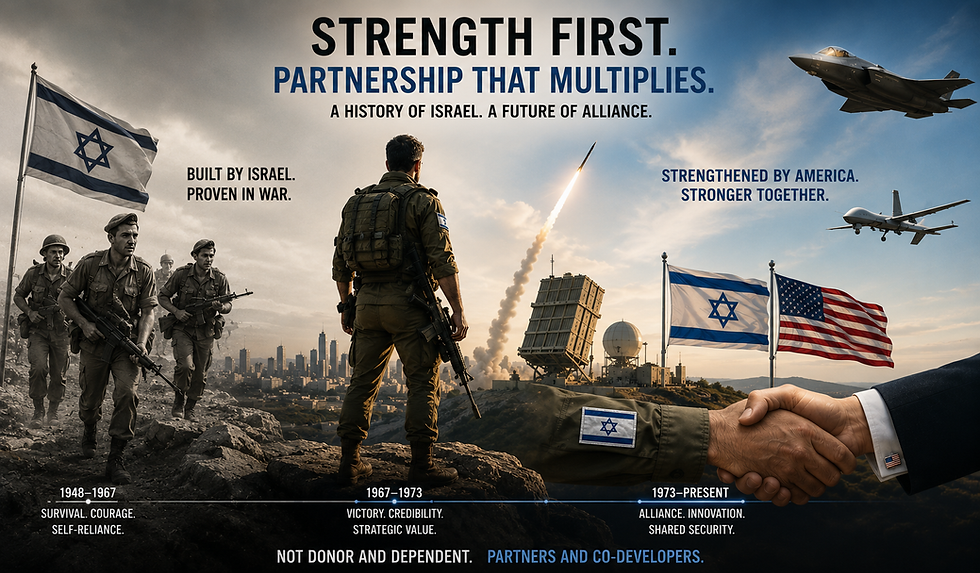
Vice President JD Vance recently argued that "two-thirds of the defensive weapons that have protected Israel" were built and paid for by American taxpayers. While the remark accurately reflects the scale of current American security assistance, it also reinforces a common misconception: that American aid created Israel's military strength.
The historical record suggests the opposite.
The United States did not build Israel's military power. For much of Israel's first two decades, Washington was reluctant to provide significant military assistance at all. By the time substantial American arms sales and aid began flowing, Israel had already established itself as one of the world's most capable military powers, repeatedly defeating larger armies equipped by the Soviet Union and demonstrating immense strategic value to the West during the Cold War.
None of this diminishes the importance of American support. U.S. military assistance has saved Israeli lives, strengthened deterrence, and helped build one of the most successful alliances in modern history. But it does challenge the increasingly common portrayal of the relationship as one of donor and dependent.
The real story is more interesting—and more relevant today. American aid was not an act of charity toward a weak ally. It was a strategic investment in a proven partner that generated military, technological, intelligence, and economic returns for both countries.
Today, as Prime Minister Benjamin Netanyahu discusses gradually reducing Israel's dependence on the financial component of American military assistance, the debate has become even more important. The question is no longer whether the alliance should continue rather how it should evolve.
Israel Became Strong Before America Became Its Arsenal
Despite strong American sympathy for Israel's creation, military cooperation developed slowly.
Following Israel's establishment in 1948, President Harry Truman quickly recognized the new state but maintained an arms embargo designed to prevent escalation of the Arab-Israeli conflict. American policymakers worried about alienating Arab governments and disrupting broader regional interests. Early U.S. assistance focused primarily on economic support rather than military aid.
Throughout the 1950s, Israel relied largely on domestic ingenuity and alternative suppliers, most notably France. During those formative years, Israel fought wars of survival, absorbed massive waves of immigration, built its military institutions, and established a culture of innovation and self-reliance—with little direct American military support.
The relationship began to shift under President John F. Kennedy. In 1962, Kennedy approved the sale of Hawk anti-aircraft missiles to Israel, the first major direct American weapons sale to the Jewish state. It was a significant milestone, but military cooperation remained limited by today's standards.
The real transformation came after the Six-Day War in 1967. Israel's stunning victory over Soviet-equipped Arab armies fundamentally altered Washington's perception of the country. Rather than viewing Israel primarily as a regional liability, American policymakers increasingly saw it as a valuable strategic asset in the broader Cold War competition against Soviet influence in the Middle East.
Israel's battlefield successes also provided valuable intelligence about Soviet military equipment, tactics, and doctrine. The lesson for Washington was clear: Israel was not becoming strong because of American support. American support was increasing because Israel had already proven itself strong.
This distinction matters because it challenges a narrative that has become increasingly common in some policy circles—that Israel's security is essentially a product of American generosity. History suggests otherwise.
The Partnership Was Forged in War
The Yom Kippur War of 1973 transformed the relationship permanently. When Egypt and Syria launched their surprise attack, Israel suffered severe losses in the opening days of the conflict. Recognizing the stakes, President Richard Nixon authorized Operation Nickel Grass, a massive airlift that delivered critical military supplies to Israel.
The operation helped Israel recover, regain the initiative, and ultimately push back the invading forces. It also signaled to the Soviet Union that the United States was prepared to stand firmly behind its regional partner. The war marked a turning point. Military cooperation expanded significantly in the years that followed, and by the mid-1980s American assistance had largely transitioned from loans to grants.
Importantly, this support was not provided because Israel was helpless. It was provided because American leaders increasingly viewed Israel as a uniquely capable ally in a strategically vital region. Throughout the Cold War, Israel consistently demonstrated military effectiveness against Soviet-backed adversaries, provided valuable intelligence, and helped advance American interests in a volatile part of the world.
Aid followed strategic value rather than creating it. That is, Israel proved itself as a valuable ally before the US decided to invest in Israel’s military.
Why U.S. Military Aid Benefits America Too
Critics often portray military assistance to Israel as a one-way transfer of American taxpayer dollars. In reality, the relationship has long been structured to provide substantial benefits to both countries. Under the current ten-year Memorandum of Understanding signed in 2016, Israel receives approximately $3.8 billion annually in security assistance. The overwhelming majority of those funds must be spent on American-made defense systems through the Foreign Military Financing program.
As a result, much of the money flows directly back into the United States through purchases from American defense companies such as Lockheed Martin, Boeing, RTX, and numerous suppliers across the country. The economic benefits are meaningful. American jobs are supported, production lines remain active, and the U.S. defense industrial base gains additional scale and stability. But the strategic returns are arguably even greater.
Over the decades, Israel has become one of America's most valuable defense laboratories and security partners. Jointly developed systems such as Arrow, David's Sling, and Arrow-3 have advanced missile defense capabilities for both countries. Iron Dome, originally developed in Israel, is now partially manufactured in the United States and has influenced American thinking about air and missile defense.
Israeli intelligence has repeatedly contributed to American counterterrorism operations, Iranian threat assessments, cyber defense initiatives, and emerging military technologies. Israeli operational experience confronting rockets, drones, ballistic missiles, tunnels, and hybrid terrorist organizations has generated lessons that have been incorporated into American military planning and procurement.
Joint exercises such as Juniper Oak and Juniper Falcon have deepened military interoperability and strengthened cooperation between the two armed forces. In many respects, what began as a traditional aid relationship evolved into something much larger: a joint research-and-development ecosystem that benefits both countries.
Seen through this lens, describing the relationship simply as "aid" misses its true nature. Successive American administrations and Congresses expanded cooperation not out of charity, but because they concluded that the strategic, military, technological, and economic returns justified the investment.
Israel Already Weaned Itself Off One Form of Aid
The current debate is not occurring in a vacuum. Israel has already demonstrated that reducing dependence on foreign assistance is possible. For decades, Israel received substantial American economic aid alongside military support. But as Israel's economy matured, successive governments deliberately phased out those grants. By the late 2000s, economic aid had ended entirely. The rationale was straightforward: a prosperous country should not depend indefinitely on foreign assistance for its economic wellbeing.
Today, Netanyahu is proposing a similar evolution in the military sphere. Part of the motivation is strategic. Recent conflicts exposed the risks associated with dependence on foreign supply chains and political decision-making. Israeli leaders increasingly seek the ability to produce larger quantities of critical munitions and military systems domestically.
Part of the motivation is economic. Israel's defense industry has become a global leader in missile defense, drones, cyber security, artificial intelligence, and advanced military technologies. Defense exports have reached record levels, making Israel one of the world's most significant defense innovators.
Ironically, the structure of American aid itself has strengthened the case for greater independence. Historically, Israel was permitted to spend a portion of American assistance on domestic procurement through a mechanism known as offshore procurement. Under the current agreement, that exception is being phased out. By 2028, virtually all aid funds must be spent in the United States.
As Israel's defense industry becomes increasingly sophisticated, many policymakers believe direct investment in domestic production may provide greater long-term strategic value than continued reliance on aid.
The Debate Over Aid Is Not One Debate
Calls to reduce or eliminate American military aid come from very different political perspectives and should not be treated as a single position.
Some critics oppose specific Israeli policies and seek greater leverage over Jerusalem. Others object to foreign assistance generally and question why wealthy allies receive support. Still others oppose Israel's legitimacy altogether and view aid reduction as a means of weakening the Jewish state.
Israel's own argument for greater self-reliance is fundamentally different.
For many Israeli leaders, reducing dependence on aid is not about weakening the alliance but strengthening Israel's ability to act independently while preserving close cooperation with Washington. The objective is not less partnership, but a more balanced one. This distinction matters because discussions about military aid often become trapped between two false choices: permanent dependency or strategic divorce.
Neither reflects reality. The U.S.-Israel relationship has become far too integrated—militarily, technologically, economically, and politically—to be reduced to a simple question of annual funding levels.
From Dependency to Partnership
The lesson of history is not that American money bought Israel's security. Israel's military strength was built first by its citizens, soldiers, scientists, entrepreneurs, and leaders. Long before substantial American aid arrived, Israel had already demonstrated extraordinary resilience, military competence, and strategic value.
American leaders chose to invest in Israel because they believed that partnership served American interests. Over time, that investment generated significant returns through intelligence cooperation, military innovation, technological development, and regional deterrence. American assistance did not create Israel's value rather it recognized it and doubled down on it. That is why the future of the alliance should not be framed as a debate over whether America continues to "give" aid to Israel. The more important question is how two increasingly capable allies can best leverage their respective strengths for mutual benefit.
If the first phase of the U.S.-Israel alliance was built on recognizing Israel's value, the next phase should be built on maximizing it together—not as donor and recipient, but as co-developers, strategic investors, intelligence partners, and technological allies.
Dan Feferman is the co-editor-in-chief of MiddleEast24. He is a former strategic and defense analyst with the Israel Defense Forces and has written extensively on the US-Israel strategic defense relationship.
Dan Feferman is the co-founder and co-editor of Middle East 24, and a former strategic advisor and intelligence analyst for the Israel Defence Forces.